
 Grid Science Solutions, LLC
Background of State-Estimator-Plus (SE+)
A groundbreaking software company revolutionizing electric smart grid monitoring
Power system state estimation is becoming increasingly critical for safe and reliable grid operations as the operating environment grows more complex and volatile. The rapid expansion of AI training centers and data centers is introducing unprecedented power demands that can increase by hundreds of megawatts within short timeframes. Unlike traditional industrial loads, these facilities exhibit fast, large, and highly correlated load changes, placing significant stress on transmission and distribution networks. Under such conditions, operators require highly accurate and timely system visibility to maintain situational awareness and prevent cascading failures.
At the same time, extreme weather events are occurring more frequently and with greater intensity, further increasing operational risk. Heat waves, winter storms, hurricanes, and wildfires can simultaneously affect generation, transmission, and load behavior, often causing rapid topology changes, measurement degradation, and parameter uncertainty. These events reduce system margins and leave little room for error. In this environment, reliable state estimation becomes essential for detecting hidden problems, validating system models, and supporting fast, informed operational decisions. A robust state estimator provides operators with a trusted, real-time view of the grid—enabling safer operation, faster response to disturbances, and greater resilience in the face of growing uncertainty.
In March 2020, the North American Electric Reliability Corporation (NERC) conducted a survey to investigate the causes of Energy Management System (EMS) failures. EMS is a computer-aided tool used by system operators to monitor, control, and optimize the performance of generation and transmission systems. According to the survey, 45% of EMS failures were attributed to state estimator divergence.
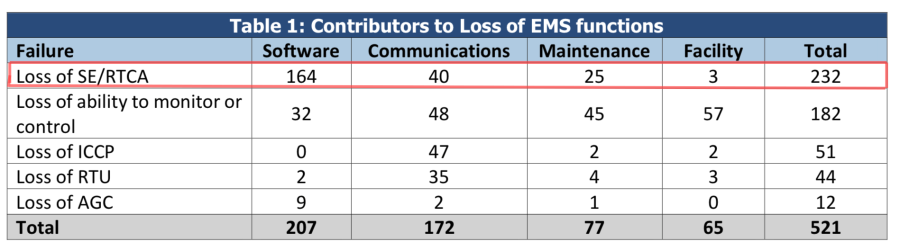
Cited: <Risks and Mitigations for Losing EMS Functions Reference Document – Version 2>, NERC survey, March 2020
The Role of State Estimators in EMS and the Revolutionary SE+ Solution
Importance of state estimators in EMS
The state estimator is a crucial core function within an Energy Management System (EMS), serving as the foundation for various network applications such as Power Flow and Contingency Analysis. Considered the "heart" of EMS, the state estimator ensures consistency and accuracy, providing a reliable base case that is essential for optimal system monitoring and control.
Challenges with conventional state estimators
Traditional state estimators, such as those based on Weighted Least Squares (WLS), often face challenges related to divergence and biased solutions. These issues can compromise the reliability and accuracy of the EMS, leading to suboptimal performance and increased vulnerability to system failures.
The Revolutionary SE+ Solution
The Accurate Non-Divergent State Estimator (SE+) represents a significant advancement in addressing the limitations of conventional state estimators. SE+ effectively resolves issues of divergence and biased solutions by ensuring that the voltage solution is determined solely by the measurement configuration, system topology, and parameters, which eliminates the need for human intervention, adjustments, or any form of linearization or approximation.
Key Benefits of SE+
- Precision and reliability: SE+ delivers precise and reliable results, enhancing the efficiency and accuracy of power system monitoring and control.
- Automatic bad data rejection: SE+ rejects bad measurements automatically, ensuring more accurate estimate of system operating state.
- Guaranteed convergence: SE+ guarantees 100% convergence whenever the system is observable, addressing a major limitation of traditional state estimators.
- Faster calculations: SE+ is significantly faster than conventional state estimators, making it highly suitable for real-time applications.
- Adaptability: SE+ can handle a wide range of system conditions and contingencies, making it a versatile tool for modern power grid management.
Enhancing EMS with SE+
By leveraging SE+, power system operators can achieve a higher level of accuracy and reliability in their EMS, ensuring consistent and optimal performance. This cutting-edge technology represents a transformative step forward in power system monitoring and control, addressing longstanding challenges and setting new standards for efficiency and precision.
In conclusion, the integration of SE+ into EMS enhances the overall resilience and performance of power grids, ensuring that system operators can effectively manage and optimize the generation and transmission of electricity, even in the face of complex and challenging conditions.

Questions?
To request a trial version of our product or have any questions about our products or services, please email to
contact@smart-elecgrid.com
Or use our contact form.
News
Check our news page regularly to find out what`s going on at Grid Science Solutions, LLC!
 Share
Share Print
Print 